Maurilio Lovatti
Saint Aloysius Gonzaga among the plague victims by Giacomo Zoboli, in the basilica of saint Ambrogio e Carlo al Corso in Rome
(1726)
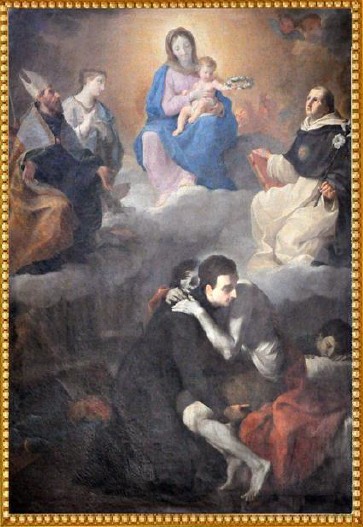
The painting is preserved in the chapel dedicated to Saint Philip Neri in the Basilica of Santi Ambrogio e Carlo al Corso in Rome.
Saint Aloysius Gonzaga (1568-1591), a Jesuit friar, devoted himself to caring for the sick during the plague epidemic that struck Rome in 1590. While carrying a dying man on his shoulders, he contracted the disease and died: he was only 23 years old. Pope Benedict XIII canonized him on December 31, 1726, along with another Jesuit, Saint Stanislaus Kostka (1550-1568), who also died very young. In preparation for the canonization, the Jesuits commissioned Giacomo (Jacopo) Zoboli (1681-1767) to create a series of banners for the ceremony: eight medallions painted "in the style of tapestry," as well as two oil paintings on canvas dedicated to the two Jesuit saints. The painting dedicated to Saint Stanislaus depicts him receiving the Eucharist. The commission of the paintings to Zoboli was decided by the superior general of the order, the Modenese theologian Michelangelo Tamburini (1648-1730).
Immediately after the canonization ceremony, Pope Benedict XIII decided to purchase the two paintings for a total of 400 silver scudi and had them placed in the Quirinal Palace. Pope Benedict XIV (1740-1758) had them moved to his summer residence in Castel Gandolfo. Pope Pius IX (1846-1878) donated them to the Basilica of Saints Ambrose and Charles on the Corso in Rome.
The painting depicts Saint Aloysius Gonzaga assisting a plague patient, attempting to take him to a hospital so he can be treated and saved. In the upper part of the painting, the Virgin Mary can be seen holding the baby Jesus, placing a crown of roses on the Jesuit saint's head. The Madonna is surrounded by three saints: Saint Augustine, Saint Catherine of Alexandria, and Saint Thomas Aquinas. The iconography is not very common, but the choice to depict Saint Aloysius assisting a sick man is a clear reference to the cause of his death at a young age. Although caring for the sick was part of the Jesuit order's mission, paintings depicting it are rare. The painting's setting is influenced by the teachings of Carlo Maratta (1625-1713). Zoboli actually arrived in Rome around 1713-14 and probably never met him; he was, however, an admirer: he was inspired by his classicist tendencies, opposed to the effusions and redundancy typical of the Baroque of the late seventeenth and first half of the eighteenth centuries, and throughout his long career as a painter he never significantly deviated from the orientation he had developed since his arrival in Rome. In the painting, Saint Louis is captured in the moment in which he is about to begin lifting the plague patient and embracing him, in a movement in which their two bodies are close, united by the same unfortunate fate.

Self-portrait by Giacomo Zoboli (Museo civico di Modena)
San Luigi Gonzaga di Giacomo Zoboli (in italian)
Dipinti di Giacomo Zoboli a Roma, Modena, Brescia ed altre ubicazioni (in italian)
Giacomo Zoboli and Cardinal Querini: Rome and Brescia in XVIII Century
Documents about death an burial of Giacomo Zoboli
Saint Philip Neri kneeling before the Virgin Mary (1745) by Giacomo Zoboli in the church of Santa Maria della Pace in Brescia
Saint Jerome by Giacomo Zoboli (1729)
The Death of Saint Jean François Regis by Giacomo Zoboli (1737)
Sant'Eleuterio di Giacomo Zoboli (1738) (in italian)
The Holy Family by Giacomo Zoboli (1748)
- Giacomo Zoboli (1681-1767) in Treccani -Dizionario biografico degli italiani (in italian)
- Giacomo Zoboli (1681-1767) Wikipedia
Maurilio Lovatti main list of online papers