Maurilio Lovatti
Death of Saint Jean François Regis by Giacomo Zoboli, in the Church of the Gesù in Rome
(1737)
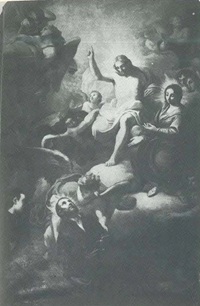
The large painting (oil on canvas, 437 x 298 cm) is kept in the sacristy of the church of the Gesù in Rome.
Jean
François Regis (1597-1640) was born in Font-Couverte, in the Languedoc
region of France, and was educated at the Jesuit college in Béziers. In 1615,
he joined the Society of Jesus (Jesuit Order) at the age of just eighteen.
After completing his first year of novitiate, he studied rhetoric and logic in
Cahors and Tournon. During his stay in Tournon, he accompanied the priest
who ministered in the small town of Andance every Sunday and taught
catechism while the priest heard confessions. In 1628, he was sent to
Toulouse to begin a theology course. A roommate told the superior, Father
François Tarbes, that John spent much of the night praying in the chapel. In
1631, Jean François was ordained and spent the rest of his life in the peasant
communities of Languedoc and Auvergne.
He preached, instructed the illiterate, and showed special concern for those in
need. His discourses were simple, unlike the erudite Jesuit preachers of his
time, yet so fervent that they attracted numerous vocations from all social
classes. He spent his mornings in the confessional, at the altar, and in the
pulpit, while in the afternoon he devoted himself to prisoners and the sick in
the hospital. He worked for years in the Montpellier and Sommières
area, from where he would set out to visit the most remote places, gaining the
trust of the people, with whom he spoke in their dialect. His success in
Montpellier and Sommières prompted Louis-François de la Baume, Bishop
of Viviers, to ask him to celebrate religious services, along with
another Jesuit in his diocese, which had suffered greatly as a result of the
prolonged religious and civil struggle. Traditionally, many residents were
Calvinists, but so far removed from the religion that there was little
difference between them and those who were Catholic in name only. Bishop de la
Baume undertook a thorough visit of his diocese. Father Regis preceded him by a
day or two, leading the mission. This was the beginning of a three-year ministry,
during which he achieved remarkable results in restoring religious observance in
those areas. His primary desire was to travel to Canada, then French, to become
a missionary, but his superiors refused permission.
He spent the last four years of his life in Velay. His influence reached
all classes and brought about a true and lasting spiritual revival. Father Regis
established and organized a social service, with staff to care for prisoners,
for sick and the poor people. Wealthy people offered him money, which he used to
finance the construction of a granary for the poor and a shelter for women and
children. This last undertaking caused him problems: some local men opposed the
construction of the women's shelter, casting a shadow over his work; even the
Jesuit Order investigated his activities. For a time, his work was hindered by a
fearful superior, but Father Regis made no attempt to justify himself. He was
much loved by the local people, and his fame grew. In the autumn of 1640,
he organized a mission to La Louvesc with another Jesuit. They set out in
bad weather, lost their way, and spent the night in a ruined house in the woods,
tormented by the biting wind. Father Regis, completely exhausted, fell ill with
pleurisy, but continued the journey to La Louvesc, where he gave three homilies
on Christmas Day and three on St. Stephen's Day, spending the rest of the time
in the confessional. At the end of the last homily, he tried to hear confessions
again, but suffered a second attack. Taken to the parish priest's house, he died
on New Year's Eve, at the age of 43.
The painting depicts Jean François in the moment immediately before his death, gazing raptly at Jesus and the Madonna, placed in the upper part of the painting, which is characterized by marked light contrasts, which are evident despite its less than optimal state of preservation. The depiction of the angels appears to be influenced by the teachings of Carlo Maratta (1625-1713). Zoboli actually arrived in Rome around 1713-14 and probably never met him; however, he was an admirer: he was inspired by his classicist tendency, opposed to the effusions and redundancy typical of the Baroque of the late seventeenth and first half of the eighteenth centuries, and throughout his long pictorial career he never significantly deviated from the orientation he had developed since his arrival in the capital. The representation of the Madonna recalls the style of Gian Gioseffo Dal Sole (1654-1719), of whom Zoboli was a pupil in Bologna for 6 years (presumably between 1701 and 1707, because in the years immediately following his presence in Modena is documented, before his definitive transfer to Rome).
Considering that the painting is undated, its similarity to the style of Gian Gioseffo Dal Sole might lead to the supposition that the work belongs to an earlier phase of the painter's career and was therefore created around the time of Jean François Regis's beatification (which took place on 24 May 1716, during the pontificate of Clement XI). This hypothesis, however, is contradicted by the depiction of the halo around the subject's face, which is entirely similar to that of Jesus and the Madonna and a clear sign of holiness. The painting was therefore presumably created on the occasion of his canonization, on 16 June 1737, celebrated by Clement XII, whose nephew and Secretary of State, Cardinal Neri Maria Corsini (1685-1770), was the painter's greatest supporter and protector in the 1730s and 1740s.
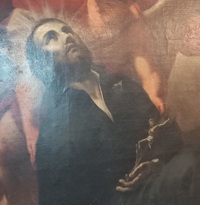
(Death of Saint John Francis Regis, detail of the Saint's face)
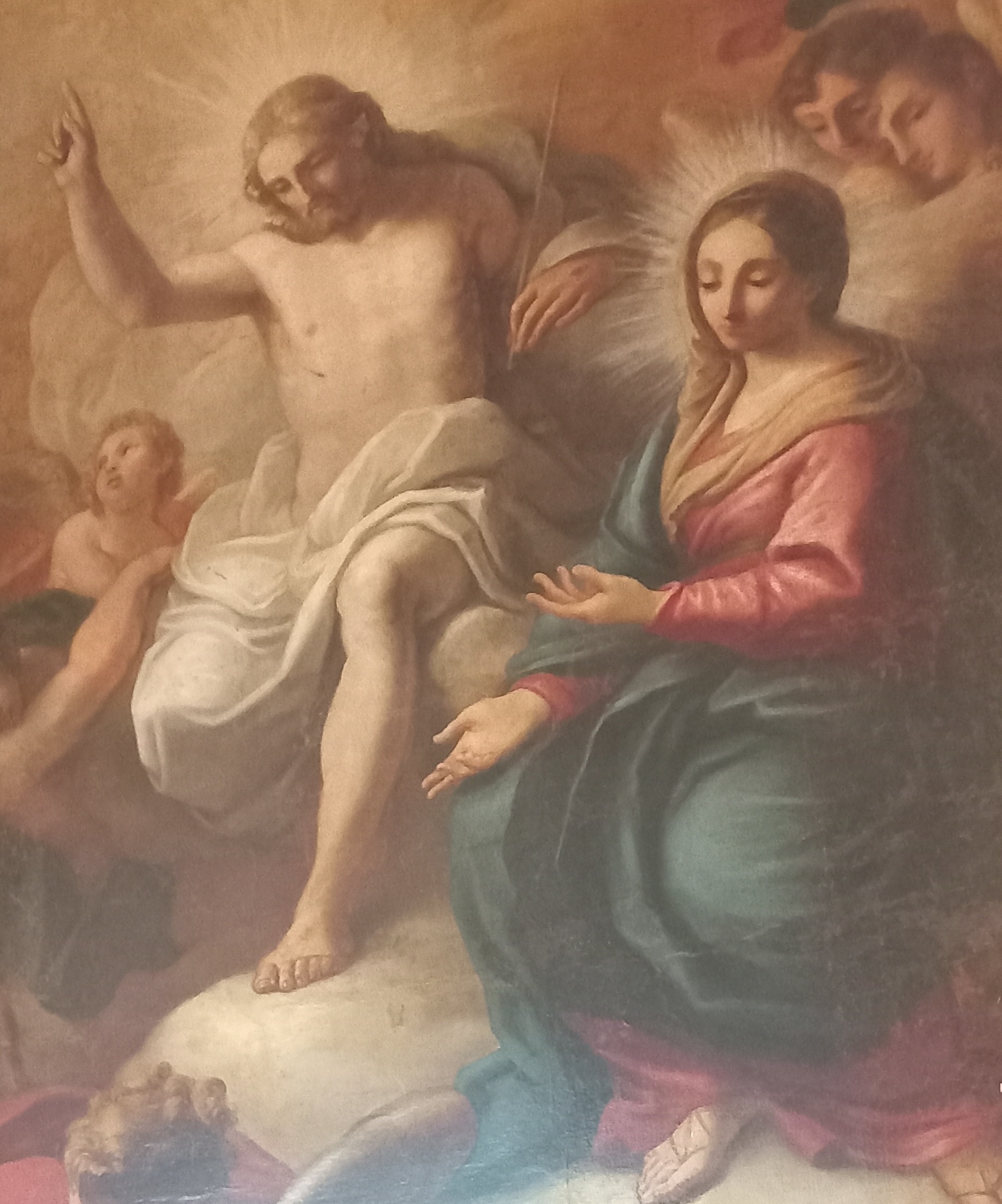
(Death of Saint John Francis Regis, Jesus and the Madonna)

Self-portrait by Giacomo Zoboli (Museo civico di Modena)
Morte di San Givanni Francesco Regis di Giacomo Zoboli (in italian)
Dipinti di Giacomo Zoboli a Roma, Modena, Brescia ed altre ubicazioni (in italian)
Giacomo Zoboli and Cardinal Querini: Rome and Brescia in XVIII Century
Documents about death an burial of Giacomo Zoboli
Saint Philip Neri kneeling before the Virgin Mary (1745) by Giacomo Zoboli in the church of Santa Maria della Pace in Brescia
Saint Jerome by Giacomo Zoboli (1729)
Sant'Eleuterio di Giacomo Zoboli (1738) (in italian)
The Holy Family by Giacomo Zoboli (1748)
- Giacomo Zoboli (1681-1767) in Treccani -Dizionario biografico degli italiani (in italian)
- Giacomo Zoboli (1681-1767) Wikipedia
Maurilio Lovatti main list of online papers