Maurilio Lovatti
Saint Jerome hears the trumpet of the last judgment by Giacomo Zoboli in the Basilica of Saint'Eustace in Rome
(1729)
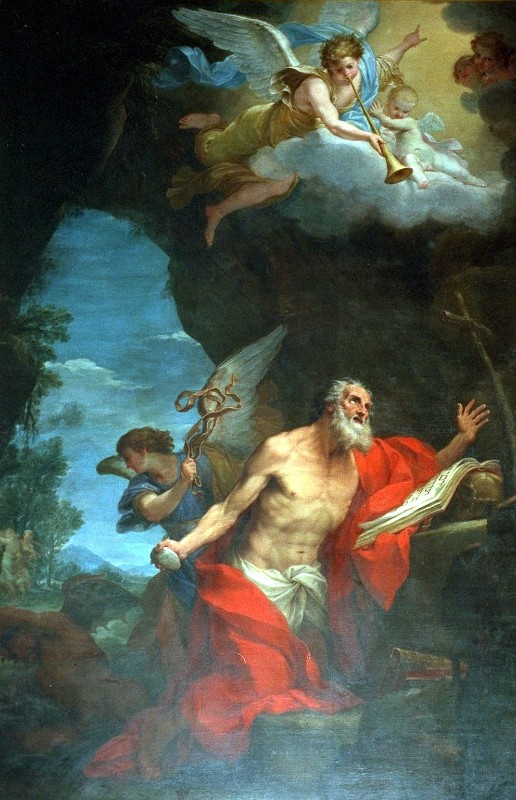
The large painting (550 x 350 cm), signed and dated, is preserved in the right transept of the Basilica of Sant'Eustachio in Rome.
The medieval
church dates back to the 10th century, when, during the reign of Pope
Celestine III, between 1095 and 1096, a new place of worship with a bell
tower was built on the site of an ancient oratory from the time of Emperor
Constantine (on the site where, according to tradition, Saint Eustace
was martyred). Between 1700 and 1701, the main body of the medieval church was
demolished, with the exception for the bell tower, because the flooding of the Tiber had
irreparably damaged the building. The church was rebuilt in two phases: from
1701 to 1706, from the portico to the crossing, and only between 1724 and
1726, were the transepts and presbytery completed.
For this basilica, the painter Giacomo Zoboli (Modena 1681 - Rome 1767) created
two large works: The Visitation (in the left transept) in 1727 and
Saint Jerome in 1729, immediately after the completion of the basilica's
reconstruction. Both works were painted in the painter's workshop in Palazzo
Venezia, granted by Cardinal Angelo Maria Querini (Venetian,
titular cardinal of the Basilica of San Marco Evangelista al Campidoglio from
1728 to 1743 and bishop of Brescia from 1727 to 1755). For the Visitation,
the place where the painting was made is documented by the receipt of payment for the transport of the painting (the receipt dated 18 November 1727
states that the fee was due for the "labor involved in lowering the
painting of the Visitation made by Zoboli from the hall of the Palazzo Venezia
into the street and for transporting it to the church", cited in Carla
Appetiti, Sant'Eustachio, Rome 1964, p. 51). For the Saint Jerome,
the transport receipt has not been found, but there is no reasonable doubt that
it was also painted in the Palazzo Venezia, where Zoboli continued to work until
1732 or 1733, before moving his workshop to the Campidoglio (from
October 1738 he lived and worked in the Palazzo Farnese, at the
time owned by the Bourbons of Naples).
The commission for the two paintings to Zoboli, as well as that of the Martyrdom of Saint Eustace for the presbytery to Francesco Fernandi, known as Imperiali (1679-1740), was formally decided by the Chapter of the church in 1726. All three paintings were paid for by the Chapter (300 silver pontifical scudi each). However, while the theme of the painting on the high altar (i.e. the martyrdom of the titular saint of the church) was obvious, we do not know exactly what role the Cardinal Titular played in choosing the type of representation of Saint Jerome in the painting. The titular cardinal of the church was Curzio Origo (1661-1737), formally titular from 1716 until his death. In reality, from 1717 to 1721 he was Papal Legate in Bologna, and only after his return to Rome in 1721 did he take a direct interest in the reconstruction work of the church, which was then carried out between 1724 and 1726. In particular, his family, owners of the Origo Palace at Via di Torre Argentina 21, had been the concessionaire of the chapel of Saint Jerome for the previous century, where the cardinal wished to be buried (and where he was indeed buried). The chapel of San Girolamo (Saint Jerome), like that of the Visitation, no longer exists: the altar (originally from the Origo Palace), which the cardinal had placed in the right transept of the newly rebuilt church, was removed during the resurfacing of the flooring in 1855 and replaced by the current wooden confessional, which we can see beneath Zoboli's painting. In the same year, the altar of the chapel of the Visitation in the left transept, granted to the family of Cardinal Cristoforo Giacobazzi (titular of the church from 1537 to 1540), was also removed and replaced by a confessional. Since Cardinal Origo was particularly devoted to the Saint, in his dual role as titular cardinal and concessionaire of the chapel, he certainly agreed with the painter on the manner in which Saint Jerome was to be depicted. We do not know, however, who may have supported, suggested, or proposed the name of the Modenese painter to the cardinal. It is likely that it was the Jesuits, with whom Zoboli regularly collaborated (the order's superior general, from 1706, was the Modenese theologian Michelangelo Tamburini). Less likely, but possible, is that Zoboli's name was suggested by Monsignor Angelo Maria Querini, who had met him while he was living in Rome (from 1714 to 1721), before being appointed archbishop of Corfu, then Venetian, in 1723. Querini commissioned the large altarpiece of the Assumption in the Duomo Nuovo in Brescia in 1732. From Monsignor Querini's extensive correspondence, we know that he personally knew Cardinal Origo: the Queriniana Library, the Diocesan Historical Archives of Brescia, and the Querini Stampalia Foundation in Venice hold several letters between the two prelates, dating from 1727 to 1735. At the time when the paintings were commissioned (between 1725 and April 1726), Querini was in Corfu; However, it is clear from the correspondence that he stayed in Lecce during August and September 1725, and we do not know whether he also travelled to Rome (at the time, a carriage journey between Lecce and Rome took an average of five or six days), nor do we know whether any other letters were exchanged between the two prelates apart from those that have been preserved. Querini was certainly in Rome in May and June 1726 for his ad limina visit, but the commissions for the paintings had already been assigned the previous month.
In the painting, Saint Jerome is depicted in a posture very similar to the classic depiction of the Saint in the famous painting by Titian Vecellio (c. 1488–1576) preserved at the El Escorial, and even the position and color of his cloak are similar. The Saint's face is slightly turned toward the viewer compared to Titian's painting. In addition to the classic stone with which Saint Jerome beat his chest and the sacred books (Saint Jerome translated the Old and New Testaments from Greek to Latin between 390 and 404), the rocky arch of the desert cave also recalls Titian's famous painting.

Saint Jerome by Titian Vecellio painted in 1575 for the King of Spain Philip II
In the upper part of the painting, the angel's trumpet may refer not to the Last Judgment, but to the story in the Golden Legend by the Dominican friar Jacopo da Varazze (Varagine): the Saint dreams of being led to God's judgment, accused of being "a Ciceronian, not a Christian" because of his excessive love of Cicero's philosophy at the expense of the Scriptures. The other angel is brandishing a whip, perhaps as an allusion to the dream in which "the judge ordered that he be severely beaten". This interpretation is, however, open to question, as the angel with the whip is looking towards the devil and not the saint.
Zoboli, however, introduces two highly innovative elements compared to the typical iconography of Saint Jerome from the 16th and 17th centuries. The most significant of these is the presence of the three dancing girls on the far left of the painting. They explicitly recall what the Saint wrote: "I, who had inflicted such a harsh prison on myself out of fear of hell, with no company but wild beasts and scorpions, often seemed to find myself among dancing maidens. My face was pale from fasting, yet, in a body now withered, my thoughts burned with desire; before the mind of a man already dead in the flesh, the fire of passion boiled" (Jerome, Epistle XXII, to the nun Eustochium). We can know with certainty that Giacomo Zoboli did not read Jerome's text himself (because at the time the saint's letters were available only in Latin). It is possible that he learned of the episode from a preacher in the church of the Sacred Stigmata of San Francesco, where he attended mass daily since August 1718, when he was admitted to the Archconfraternity of the same name. Or the detail could have been suggested to him by Cardinal Curzio Origo, who, although primarily an administrator lacking a solid theological background, was nevertheless a devout admirer of Saint Jerome.
The second detail that differentiates Zoboli's painting from Titian's one is the replacement of the lion, a classic characteristic element of the iconography of Saint Jerome the Penitent and a symbol of tamed passions (according to the legend of Jacopo da Varazze, the Saint had found the courage to approach the ferocious beast to remove a thorn from its paw and from that moment on it transformed into a docile, faithful animal, which always remained close to Jerome) with the defeated Demon, in the form of a fallen angel.
Otherwise, the
landscape, far from resembling that evoked in Jerome's epistle ("this
boundless desert, scorched by a torrid sun"), is very similar to
Titian's, rich in vegetation and with glimpses of mountainous reliefs. Even the
play of light between the direct light illuminating the Saint and the background
light, coming from beyond the rocky semi-arch, echoes that of the great
Venetian painter.
Zoboli prepared the painting with great care. Around ten preparatory drawings
have been
documented, mostly focusing on the postures of the Saint and the angel. This
painting was highly appreciated at the time and brought the painter
international fame. Zoboli's two paintings in the church of Sant'Eustachio were
greatly admired by Cardinal Neri Maria Corsini (1685-1770), nephew of Pope
Clement XII, who later, in the 1730s and 1740s, was the painter's greatest
supporter and protector.

Self-portrait by Giacomo Zoboli (Museo civico di Modena)
San Girolamo di Giacomo Zoboli (in italian)
Dipinti di Giacomo Zoboli a Roma, Modena, Brescia ed altre ubicazioni (in italian)
Giacomo Zoboli and Cardinal Querini: Rome and Brescia in XVIII Century
Documents about death an burial of Giacomo Zoboli
Painting by Giacomo Zoboli in Rome, Modena, Brescia end in other locations (in italian)
Giacomo Zoboli and Cardinal Querini: Rome and Brescia in XVIII Century
Saint Aloysius Gonzaga by Giacomo Zoboli (1726)
Death of Saint Jean Francois Regis by Giacomo Zoboli (1737)
The Holy Family by Giacomo Zoboli (1748)
Saint Philip Neri kneeling before the Virgin Mary (1745) by Giacomo Zoboli in the church of Santa Maria della Pace in Brescia
Sant'Eleuterio di Giacomo Zoboli (1738) (in italian)
- Giacomo Zoboli (1681-1767) in Treccani -Dizionario biografico degli italiani (in italian)
- Giacomo Zoboli (1681-1767) Wikipedia