Maurilio Lovatti
Vision of Saint Andrew Corsini by Giacomo Zoboli in the Church of Gesù Bambino all'Esquilino.
(1738)
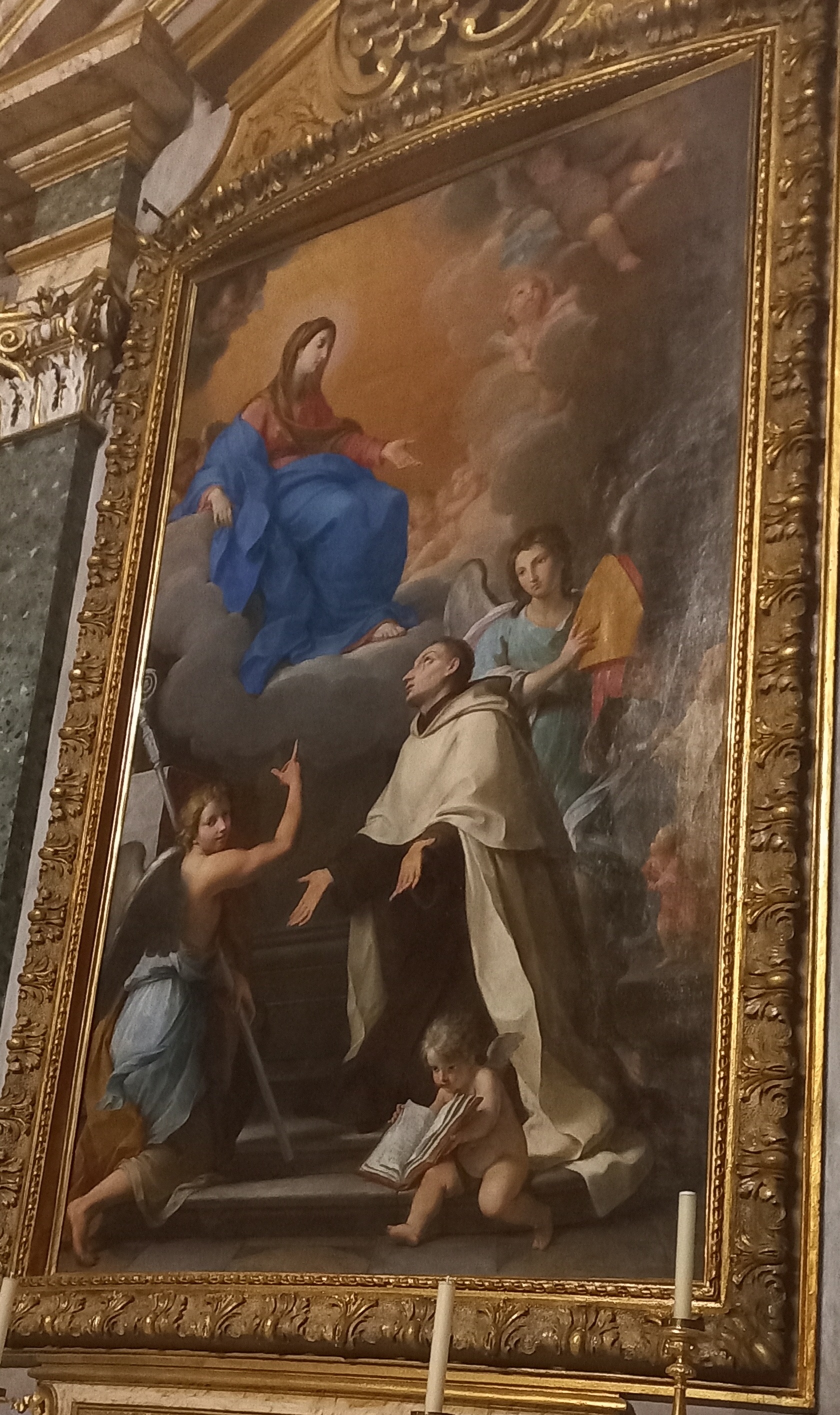
The painting is
housed at the left side altar in the Church of Gesù Bambino all'Esquilino
in Rome.
The church, serving the convent of the Congregation of the Oblate Sisters of
the Santissimo Bambin Gesù, founded in 1671, was built in the first
half of the 18th century. In 1722–23, Pope Clement XII of the Corsini
family, who as a cardinal had been the protector of the Congregation of the
Sisters, provided substantial funding for its construction. The church,
completed in 1736 under the direction of the renowned architect Ferdinando
Fuga (1699–1782), was consecrated by Archbishop Monsignor Cristoforo
Almeyda, born in 1690, who had served as Apostolic Protonotary from 1729 to
1735 and had been Assistant to the Papal Throne since 1736. Cardinal Neri
Maria Corsini (1685–1770), nephew of Clement XII, chose the three painters
who were to decorate the church. Marco Benefial (1684–1764) was
commissioned to paint The Adoration of the Shepherds for the high altar; Domenico
Maria Muratori (1661–1742) was commissioned to paint Saint Augustine
Triumphing over Heresies for the right-hand side altar; and Giacomo
Zoboli, also known by Jacopo, (Modena 1681 – Rome 1767) was
commissioned to paint the most important work, intended to commemorate Saint
Andrew Corsini, a member of Pope Clement XII’s family and a distinguished
benefactor of the church on the Esquiline Hill.
The painting was produced in 1738, a pivotal moment in Zoboli’s life, as it was in that year that he moved his home and studio to Palazzo Farnese, which at the time was owned by the Bourbons of Naples: this privilege had been granted to him by Charles of Bourbon, King of Naples, at the request of Cardinal Neri Maria Corsini. Zoboli had risen to fame from 1729 onwards, when he painted Saint Jerome Hearing the Trumpet of the Last Judgement in the Basilica of Sant’Eustachio in Rome, a work greatly admired by his contemporaries. The numerous commissions received by the painter in Rome between 1727 and 1740 were mainly due to Cardinal Neri Corsini himself. The painting now in the Esquilino is the first to have been completed at Palazzo Farnese, in the last two months of 1738 (Zoboli had moved his studio from the Campidoglio to Palazzo Farnese in October 1738).
Andrea Corsini, born in Florence in 1301, became a Carmelite friar at the age of 15; after his ordination to the priesthood, he was sent to complete his studies at the University of Paris. He returned to Florence just as the plague of 1348 was raging. During that period, he distinguished himself through his charity and courage, devoting himself to the care of the sick. Upon becoming Bishop of Fiesole, he chose to reside in the bishop’s residence, declining the prestigious Florentine palace that had been the seat of his predecessors. He was zealous in his preaching, in prayer, in visiting parishes, in defending the Church’s freedom against oppression and interference, as well as in his charity towards the humble and the dispossessed, providing them with material and spiritual assistance. He would often sit at the gate of his house and distribute bread to the poor himself. He devoted special care to his priests, anticipating the teachings of the Council of Trent and establishing precise guidelines regarding the cultural and spiritual preparation of candidates for the priesthood. He also imposed a rigorous lifestyle upon himself: extreme frugality and modesty were a constant feature of his life, and even in his old age he maintained an ascetic lifestyle, despite his illness. He died on the evening of Epiphany in 1374.
The veneration of Saint Andrew Corsini spread rapidly. He was beatified by Pope Eugene IV in 1440 and canonised by Pope Urban VIII on 22 April 1629. According to legend, the saint appeared at the Battle of Anghiari (Arezzo) on 29 June 1440 to protect the Florentine army, which, allied with the Pope and Venice, was fighting against the army of the Duchy of Milan. The minor figures in the painting, behind the angel on the right and armed with spears, allude to the Battle of Anghiari. The suggestion to the painter may well have come from Cardinal Corsini, or even from Clement XII himself, as the Pope’s family frequently emphasised his Florentine origins and thus sought to highlight Saint Andrew’s role in protecting the Florentine army. It may be assumed, by analogy, that the decision to place the Bishop’s mitre and crozier in the hands of the angels, to the right and left of the saint respectively, was also explicitly suggested to the painter, with the dual purpose, on the one hand, of emphasising the saint’s humility and his very austere way of life and, on the other, to celebrate the heavenly glory of Saint Andrew’s episcopal dignity, which brought honour and prestige to the Pope’s family. The main theme of the painting, the vision of the Virgin Mary, derives from the legend – widely held at the time – that the Virgin appeared to Andrew and made him promise to accept the office of bishop. During his first Mass, the young Carmelite is also said to have had a vision of the Virgin Mary, as indicated by a 17th-century marble relief in the Corsini Chapel of the Church of the Carmine in Florence, the work of G. B. Foggini.

Self-portrait
by Giacomo Zoboli (Museo civico di Modena)
Sant'Andrea Corsini di Giacomo Zoboli (in italian)
Dipinti di Giacomo Zoboli a Roma, Modena, Brescia ed altre ubicazioni (in italian)
Giacomo Zoboli and Cardinal Querini: Rome and Brescia in XVIII Century
Documents about death an burial of Giacomo Zoboli
Saint Philip Neri kneeling before the Virgin Mary (1745) by Giacomo Zoboli in the church of Santa Maria della Pace in Brescia
Saint Jerome by Giacomo Zoboli (1729)
Sant'Eleuterio di Giacomo Zoboli (1738) (in italian)
The Holy Family by Giacomo Zoboli (1748)
- Giacomo Zoboli (1681-1767) in Treccani -Dizionario biografico degli italiani (in italian)
- Giacomo Zoboli (1681-1767) Wikipedia
Maurilio Lovatti main list of online papers