Maurilio Lovatti
The Immaculate Conception by Giacomo Zoboli in the church of Sant'Antonio dei Portoghesi in Campo Marzio, in Rome
(1756)
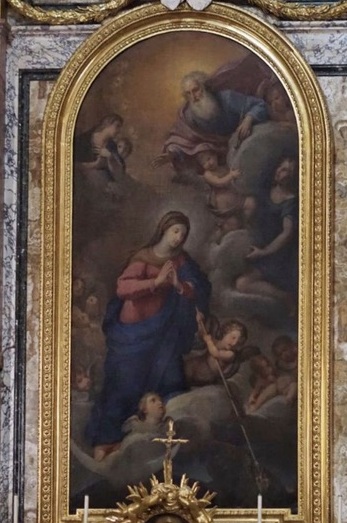
The painting is housed on the altar of the Chapel of the Immaculate Conception, in the left transept of the church of Sant’Antonio in Campo Marzio, in the Roman district (rione) of the same name.
The church of Sant’Antonio was founded in 1445 by Cardinal Antonio Martínez de Chaves on the site of a hospice for Portuguese pilgrims established by the noblewoman Guiomar of Lisbon. The hospice included a small place of worship, no larger than a modest cottage, dedicated to Our Lady of Bethlehem. Between 1624 and 1628, the original small church was enlarged and dedicated to Saint Anthony of Padua, who was of Portuguese origin.
In 1686, the present Chapel of the Immaculate Conception, in which Zoboli’s painting serves as the altarpiece, was dedicated to the Blessed Virgin of Pity. In 1748, however, Emanuel Pereira de Sampajo, the Portuguese ambassador to the Holy See, drew up his will, naming the chapel his universal heir (and expressing the wish to be buried there). He stated his intention to dedicate it to the Immaculate Conception and commissioned Luigi Vanvitelli (1700–1773) to enlarge, renovate and embellish it. Pereira de Sampajo died at Civitavecchia on 13 February 1750. Cardinal Neri Maria Corsini (1685–1770), nephew of Pope Clement XII, was appointed executor of Pereira de Sampajo’s will.
In 1752, the Portuguese Congregation transferred the chapel to the executors of the will. On 16 January 1754, a brief issued by Pope Benedict XIV granted the Chapel of the Immaculate Conception the status of a privileged altar. Work to embellish the chapel began in January 1754 and was entrusted to Carlo Murena (1713–1764), a pupil of Vanvitelli. On 8 July 1755, Cardinal Corsini commissioned Zoboli to paint the altarpiece. The Chapel of the Immaculate Conception was finally consecrated and inaugurated on 8 December 1756. By that date, Zoboli’s painting, executed at Palazzo Farnese, had already been transported to the church and installed on the chapel’s altar.
From 1738 onwards, Giacomo Zoboli (Modena, 1681 – Rome, 1767) had his residence and studio on the second floor of Palazzo Farnese, which at the time belonged to the Bourbons of Naples. He had been granted this privilege by the King of Naples, Charles of Bourbon, at the request of Cardinal Neri Maria Corsini. Zoboli had risen to prominence in 1729, when he painted Saint Jerome Hearing the Trumpet of the Last Judgement in the Roman basilica of Sant’Eustachio, a work that was highly acclaimed by his contemporaries. The numerous commissions awarded to the Modenese painter in Rome were due largely to Cardinal Neri Corsini himself.
The painting of the Immaculate Conception appears to be the last documented and dated work executed at Palazzo Farnese, where the painter lived until 1760, when he moved to Palazzo Savelli Orsini, on Via Monte Savello, in the block occupied by the Theatre of Marcellus, within the territory of the then parish of San Nicola in Carcere.
It is reasonable to suppose that Cardinal Corsini helped shape the painting’s overall conception, given that his relationship with the painter had by then lasted for more than a quarter of a century and had developed into a form of friendship and mutual esteem, despite the considerable social difference between them. In the painting, God the Father gazes approvingly at the Virgin, who in turn looks serenely towards the angel in the lower right, partially obscured by a cloud. On her behalf, the angel crushes the Devil with a long spear; the Devil is positioned in the lower-right corner of the painting. The two diagonal gazes—that of God the Father and that of the Madonna—form the painting’s principal compositional axis, drawing the viewer’s attention.
The very soft handling of colour, by contrast, appears to have been the painter’s own choice, reflecting the evolution of his style. By this time, Zoboli was already elderly: he was 75 in 1756. Indeed, a similar evolution can be observed by comparing paintings of similar subjects executed at different times. For example, in the Assumption of the Virgin in the New Cathedral of Brescia (1733–1735), Zoboli employs chiaroscuro in a forceful, vibrant manner characteristic of Caravaggio. In a painting of the same subject, executed fifteen years later, in 1748, for the Augustinian nuns of Brescia, the colours are instead delicate and pastel-like. In the Assumption in the cathedral, Zoboli almost seems intent on alarming and surprising the viewer. In the second painting, by contrast, the angel acts as a guide for the viewer, revealing what the faithful already know deep within themselves.
It is also worth noting that the Madonna does not wear a crown, unlike the customary practice in Portuguese paintings. In 1646, the King of Portugal, John IV, had proclaimed the Immaculate Conception Patroness of Portugal, offering her his own crown. From that moment onwards, Portuguese kings no longer wore a physical crown. In agreement with Cardinal Corsini, Zoboli instead chose to depict the Virgin without a crown, in keeping with the Roman tradition.
Cardinal Neri Maria Corsini and Cardinal Silvio Valenti Gonzaga (1690–1756), Secretary of State to the reigning pope, Benedict XIV, were the leading representatives of Roman Jansenism. Unlike European Jansenism, which gave priority to the question of divine grace, its Roman counterpart was directed towards combating popular superstition and the religious hypocrisy characteristic of the Roman aristocracy of the period. Both cardinals also represented a current of thought within the Church hierarchy that was particularly receptive to certain ideas of the Enlightenment. We may therefore suppose that Zoboli’s conception of the painting was significantly influenced by this cultural and religious outlook. The benevolent, serene and almost approving gaze of God the Father conveys divine omnipotence, reinforced by the Virgin’s demeanour. Unlike in the established iconographic tradition, she does not crush the Devil directly; instead, she looks on serenely and appears to endorse the angel’s action as he strikes the Devil with his spear.
Just a few years earlier, in
1747, Cardinal Gonzaga had commissioned Zoboli, together with Giovanni Paolo
Pannini (1691–1765), to appraise the paintings in the collection of
Marquis Sacchetti. The paintings were subsequently purchased by Benedict
XIV to form the nucleus of the Capitoline Picture Gallery.

Autoritratto di Giacomo Zoboli (Museo civico di Modena)
Dipinti di Giacomo Zoboli a Roma, Modena, Brescia ed altre ubicazioni (in italian)
Documents about death an burial of Giacomo Zoboli
Painting by Giacomo Zoboli in Rome, Modena, Brescia end in other locations (in italian)
Giacomo Zoboli and Cardinal Querini: Rome and Brescia in XVIII Century
Saint Aloysius Gonzaga by Giacomo Zoboli (1726)
Death of Saint Jean Francois Regis by Giacomo Zoboli (1737)
The Holy Family by Giacomo Zoboli (1748)
Saint Philip Neri kneeling before the Virgin Mary (1745) by Giacomo Zoboli in the church of Santa Maria della Pace in Brescia
Sant'Eleuterio di Giacomo Zoboli (1738) (in italian)
- Giacomo Zoboli (1681-1767) in Treccani -Dizionario biografico degli italiani (in italian)
- Giacomo Zoboli (1681-1767) Wikipedia