Maurilio Lovatti
The Coronation of the Virgin by Moretto da Brescia in the Collegiate Church of Saints Nazaro and Celso in Brescia
(1534)
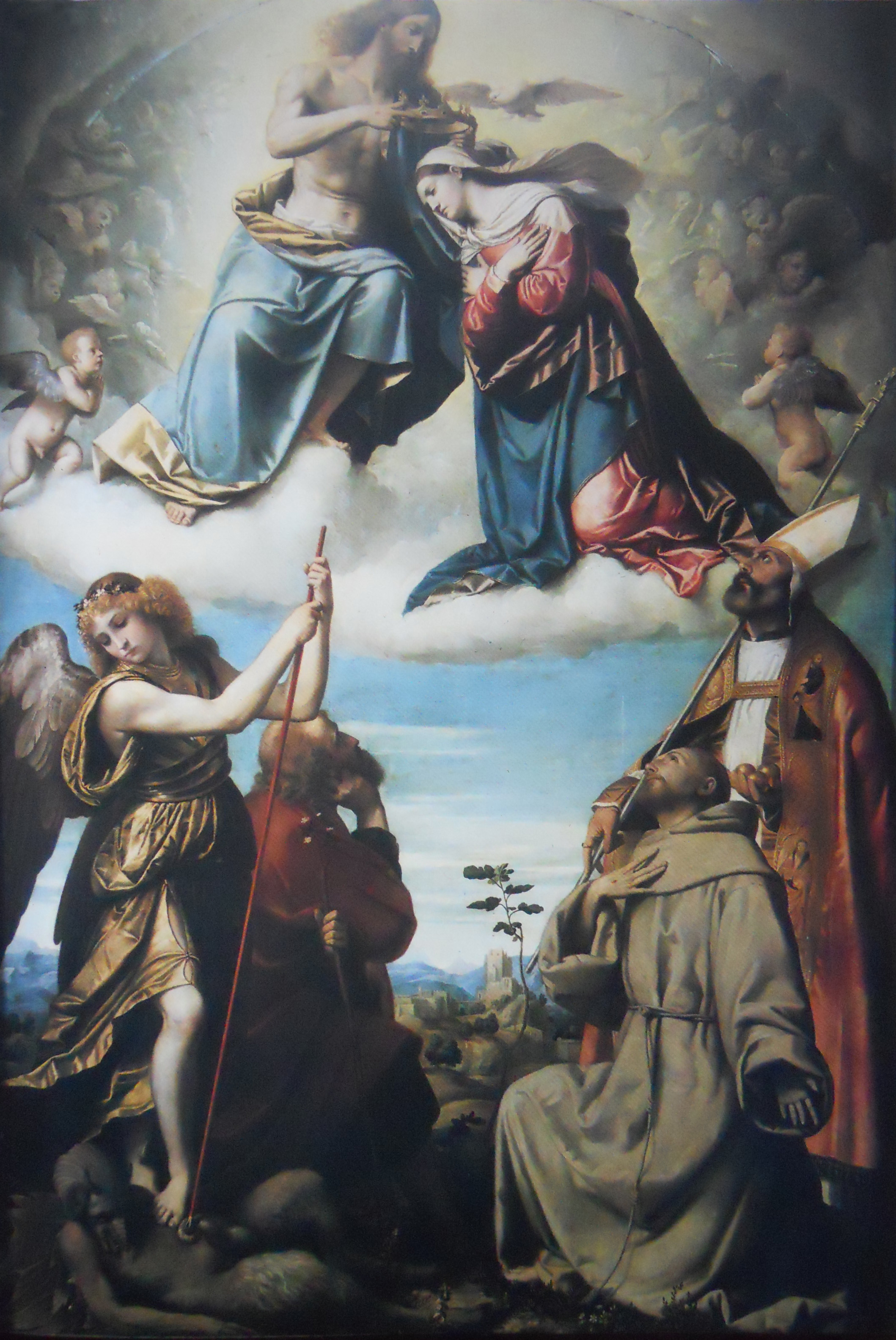
The painting is housed at the second altar on the left in the Collegiate Church of Saints Nazaro and Celso in Brescia. Originally, within the 15th-century church, the work, created around 1534, was part of an oil-on-panel polyptych. This ensemble also included a rectangular painting depicting God the Father (64x92 cm), positioned above the central panel (as it remains today); two tondos featuring the faces of the Annunciation angel and the Virgin Mary receiving the news (diameter 27 cm); and a Nativity (34x56 cm).
The original composition was therefore as follows:

Following the 18th-century renovations (between 1752 and 1780), when the church was rebuilt from the foundations up, the two roundels and the Nativity scene beneath them were not installed on the reconstructed altar; instead, they were kept in the rectory for nearly two and a half centuries. It was only after the paintings underwent restoration, completed in May 2024 with financial backing from the Young Entrepreneurs of Confindustria Brescia, that the two roundels and the Nativity scene were placed on the altar, positioned lower than the main panel.
The painting (289 × 198 cm) is one of Moretto’s great masterpieces, alongside the Assumption of the Virgin (1526) located at the high altar of the Old Cathedral in Brescia. Furthermore, it can be considered one of the most significant works depicting the Coronation of the Virgin in Italian painting between the early sixteenth and late eighteenth centuries. Even Raphael’s famous Coronation of the Virgin (the Oddi Altarpiece, 1502–1504) painted for the Oddi Chapel in the church of San Francesco al Prato in Perugia and now housed in the Vatican Museums, actually depicts the Apostles beside the Virgin’s empty tomb in its lower section, alongside the coronation itself, thereby explicitly evoking the theme of the Assumption. Moretto, by contrast, places the theme of the coronation at the center.
By the time Alessandro Bonvicino, known as Il Moretto (born in Brescia between 1492 and 1495; died in Brescia in 1554) created this painting, he was already an established artist in his forties and the most renowned painter from Brescia. He had already painted the aforementioned Assumption for the cathedral and, alongside Romanino, completed the decoration of the Chapel of the Blessed Sacrament in the church of San Giovanni Evangelista in Brescia in 1524. Moretto was regarded as the "Raphael of Brescia." As Giorgio Vasari would write in 1568, Moretto was a "most refined painter" who had mastered the art of emulating Raphael's style to perfection. When Il Moretto set out to paint the Coronation for the second altar on the left, he was well aware that the high altar of the Church of Santi Nazaro e Celso already housed, since 1522, Titian’s celebrated Averoldi Polyptych. Titian was unanimously regarded as the greatest living painter in the Serenissima Republic of Venice, of which Brescia had been a part since 1426. It is easy to understand, then, just how significant this painting was for the Brescian artist: he was pitting himself against Titian and was virtually compelled to produce his very best work. It is no coincidence that he executed the entire piece himself, without delegating a single detail to the numerous pupils in his workshop, unlike in many of his other projects. Unlike other great Brescian painters of the era, such as Romanino and Savoldo, Moretto had established an organized artistic workshop that, allowing for the difference in scale, was akin to that of Raphael. Furthermore, the two small roundels (Angel and Virgin) directly recall the Averoldi Polyptych and are an explicit tribute to the great Venetian painter.
The Coronation of the Virgin, depicted in the upper section of the main panel, takes place upon a bank of clouds surrounded by a multitude of angels. The Virgin kneels as Jesus prepares to place a crown upon her head, while the white dove representing the Holy Spirit hovers directly above; viewed from below in the uncertain light of dawn, it appears grey. The Trinity is completed by the figure of God the Father in the polyptych's upper panel, gazing downwards with outstretched arms. In the lower section of the panel, there are four figures, from left to right: Archangel Michael, Saint Joseph, Saint Francis of Assisi, and Saint Nicholas of Bari.
The archangel is the only figure not looking toward the Madonna, as he is engaged in the struggle against the devil. In the popular imagination of the sixteenth century, inherited from the Middle Ages, the battle between the Archangel Michael and the Evil One was the most readily understood representation of the conflict between good and evil. From a theological and ethical perspective, the connection between the Coronation of the Virgin and the Archangel Michael’s struggle against evil is easily grasped. Indeed, the Coronation of the Virgin holds profound theological significance; it does not merely depict Mary as the "Queen" of Heaven in an honorary sense, but makes visible the fulfillment of her participation in the glory of Christ and the salvation of humanity. The crown thus indicates that what, according to Christian faith, is destined to be fulfilled in redeemed humanity has already been accomplished in Mary: participation in the life and glory of God. Moreover, the Coronation does not merely depict Mary's individual glorification; she also becomes an image of the Church and a symbol of redeemed humanity, which can overcome the darkness of sin through Christ's death and Resurrection. The light of dawn illuminating the landscape behind the four Saints likewise alludes to the transition from the darkness of night, which represents evil, to the light of day, which represents the light of salvation. Perhaps even the tree itself, the only one clearly distinguishable in the landscape, with a trunk so slender that it seems to defy the laws governing physical reality, symbolises human frailty and precariousness, expressing the conviction that human weakness in the face of sin does not rule out the hope of salvation. Thus, both the Virgin and the archangel convey the same message: the struggle against evil can be won. This is the central message, one that every viewer at the time, even an illiterate peasant, could readily grasp. Yet Moretto's particular representation of the archangel invites further reflection. The silvery-grey tones of his wings and of part of his garment, the chiaroscuro, the serenity and composure of his face, which seems at odds with the struggle against the devil, and the painter's apparent aspiration to endow the angel with a sublimated, melancholic beauty may suggest that, when confronted with a figure as powerful, perfectly harmonious and realistic as Titian's Saint Sebastian in the Averoldi Polyptych, Moretto sought to portray a beauty that was almost perfect. Nevertheless, the apparent serenity of Saint Michael the Archangel should not deceive us. It does not mean that the struggle against the Evil One has been definitively won. The religious message the painter wishes to convey is clear: the angel is the only figure who does not look at the Virgin as she is crowned, because the struggle against evil takes precedence over everything else.
As for the other three saints, Saint Joseph, Mary's earthly spouse, could certainly not be omitted; he is masterfully portrayed in quiet contemplation. The presence of Saint Francis and Saint Nicholas of Bari, however, calls for an explanation.
Why Saint Francis? The historical context is relatively clear and well established. Between 1254 and 1265, on land donated by the Communes of Brescia, the majestic Church of Saint Francis of Assisi was built within the territory of the parish of Saints Nazaro and Celso, approximately a three-hundred-metre walk north-east of the collegiate church. It was the first example of Franciscan architecture in Lombardy. The adjoining Franciscan convent was completed in the following century. In other words, such an important Franciscan presence, significant to the city's religious and political history, within the parish boundaries was still a source of pride and prestige for the collegiate church in the sixteenth century, when Moretto painted the work. This provides a compelling explanation for the inclusion of Saint Francis in the Coronation of the Virgin. As Saint Francis contemplates the Virgin, the expression on his face conveys a kind of mystical abandonment.
Why Saint Nicholas of Bari? Sometimes, in altarpieces, saints who are not directly connected with the subject of the painting are included because they share the name of one of the patrons, or because the patron or the church's titular (Provost) has a particular devotion to them, or believes that they have received a special grace through their intercession.
The first hypothesis appears unlikely. The noble family that commissioned the chapel, and held its patronage rights, was the Soncini family; among its members at that time and in subsequent generations, no one by the name of Nicola is known. Nor can the possibility that Nicholas was the name of the collegiate church's provost be sustained: from 1531 to 1557, the Provost (often also referred to as the Preposito) of the collegiate church was Fabio Averoldi. It may therefore be hypothesised that either a member of the Soncini family or the provost, Fabio Altobelli, had a particular devotion to the saint.
A much more tenuous hypothesis would be that Moretto was inspired by an earlier and distinguished painting depicting the Coronation of the Virgin. The most relevant example from this perspective would be Fra Angelico's Coronation of the Virgin (1434–1435), now housed in the Louvre Museum, which also depicts Saint Nicholas among the assembled witnesses to the Coronation. However, this does not seem sufficient to explain why the artist would independently have chosen to include Saint Nicholas in the painting for the church of Saints Nazaro and Celso.
L'Incoronazione della Vergine di Moretto da Brescia nella chiesa Collegiata dei Santi Nazaro e Celso in Brescia (in Italian)
Dipinti di Giacomo Zoboli a Roma, Modena, Brescia ed altre ubicazioni (in Italian)
Giacomo Zoboli and Cardinal Querini: Rome and Brescia in XVIII Century