Giulio Bevilacqua (1881-1965)
Brescia, Rome and and the Second Vatican Council
edited by Maurilio Lovatti
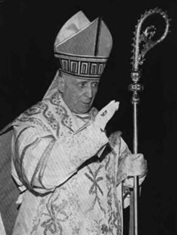
Born in Isola della Scala, in
the province of Verona, on September 15, 1881, to a wealthy family (his
father was a merchant, his maternal grandfather a doctor), Giulio was the
youngest of ten children. In 1889, the family moved to Verona,
where, during high school, Giulio met and associated with don Giuseppe
Manzini (1866-1956), a canon of the Cathedral, active in the Opera
dei Congressi, and committed to the apostolate and assistance to workers and
farmers. In 1902, he enrolled at the Catholic University of Leuven
in Belgium, where Desire Mercier, a key figure in the birth of
neo-scholastic philosophy, taught. In 1903, he enrolled at the School of
Specialization in Political and Social Sciences in Mechelen. He graduated on November
21, 1905, with a pioneering thesis on workers' legislation in Italy.
On December 1, 1905, he entered the convent of the Philippine Fathers of
the Pace Convent in Brescia, despite his parents' opposition.
He studied theology at the Seminary of Brescia, whose rector was Msgr. Giacinto
Gaggia (1847-1933), who would later become Bishop of Brescia in 1913.
He became a priest in 1908 and began teaching sociology at the
diocesan seminary. In 1912, he founded a social school for Catholic
propagandists and activists, inviting prominent figures from the Brescian
Catholic community to collaborate with him, such as Giorgio Montini (father
of the future Pope Paul VI), Carlo Bresciani, who would later
become a member of Parliament, and the Honorable Giovanni Maria Longinotti.
In the years before the war, he was primarily involved in the education of the
youth of the Pace Oratory; he had a significant influence on the
education of Lodovico and Giovanni Battista Montini, Andrea Trebeschi, Sandro
Capretti, Carlo Tagliaferri, and Pietro Bulloni, all future protagonists of
Brescian culture and politics, and many other young people.
In 1915, he supported interventionism in the First World War,
arguing that absolute pacifism was not Christian and that, in some circumstances,
it could be cowardice, a compromise, a camouflage for selfishness. War is in
itself an evil, but not an absolute evil (Fappani, 1979, p. 70-71).
He applied to become a military chaplain, but the Bishop of Brescia tried to
prevent his application from being accepted. Then, with the Bishop's permission,
he enlisted as an Alpine officer and served on the front lines in the Mount
Ortigara area from February 1917. He earned two bronze medals.
On December 4, 1917, he was taken prisoner by the Austrians and
taken to the concentration camp at Horowice Castle in Bohemia. After the war, he
returned to the Pace Convent in Brescia on December 8, 1918.
The opposition to fascism
In the early
postwar years, as part of the activities of the Philippine Fathers, of which he
was provost from 1924, he was primarily involved in youth education and liturgical
themes (he was one of the main organizers of the national liturgical week in
May 1922 in Brescia); he promoted and led weekly meetings for
Brescian professionals and worked to spread the reading of the Gospel.
During those years, his stance became consistently anti-fascist (the only
measure of the Mussolini government he appreciated was the Gentile
school reform of 1923), and he was repeatedly criticized and attacked by the
fascist press in Brescia. On the evening of Epiphany 1924, fascist squads
attacked the rectory of Fiesse, a town 40 km south of Brescia, beating up
young members of Azione Cattolica (Catholic
Action). The following day, Bishop Msgr. Giacinto Gaggia sends Father
Giulio to Fiesse to conduct an investigation (Fappani, 1979, p. 131). Fascist
threats force him to return to Brescia and take refuge in the Pace
Convent.
Thus began a long and heated controversy between Father Bevilacqua and Augusto
Turati, federal secretary of the Fascist Party, which lasted until
1928. In early November 1926, incited by the Fascist newspaper «Il Popolo di
Brescia», Fascist squads, after ransacking the editorial offices of
Brescia's Catholic newspapers and the Morcelliana publishing house, attacked the
Pace Convent, shouting "A morte padre Bevilacqua" (Death
to Father Bevilacqua), breaking down a door, and setting fire to a cell in the
convent. During this period, Father Bevilacqua was publicly defended by the Bishop
of Brescia. In 1927, he persuaded his brothers not to re-elect him as prior, to
avoid damaging the congregation (the Prefect had informed the general Vicar of
the Diocese, Msgr. Domenico Menna, that he had prepared the decree
dissolving the Pace Oratory).
The clash between fascism and the Philippine Fathers became a matter of national
importance because it threatened to negatively impact the ongoing negotiations
between the Vatican and Mussolini's government, which would lead to the signing
of the Concordat in 1929. Father Caresana, Prior of the Peace Fathers,
and the Bishop of Brescia, Msgr. Giacinto Gaggia, defended Bevilacqua,
while the national president of Catholic Action, Luigi Colombo, with the
support of the Vicar General of the Diocese, Msgr. Domenico Menna (the
future Bishop of Mantua), desiring a normalization of relations between the
Church and the fascist regime, advocated Father Giulio's removal from Brescia.
Ultimately, the Pope himself decided: Pius XI instructed Cardinal Camillo
Laurenti, Prefect of the Congregation of Rites, to summon Father Bevilacqua
to Rome as a consultant to the Congregation. On the evening of January 6,
1928, Father Giulio leaves by train for Rome.
The Roman exile
In Rome, Bevilacqua shared a home for four years with Giovanni Battista Montini (the future Pope Paul VI), then ecclesiastical assistant to the FUCI (Catholic Federation of University Students) and an official of the Secretariat of State, in an apartment in the villa of the painter Antonio Mancini, at Via Terme Deciane 11, on the Aventine Hill. A deep friendship developed between Bevilacqua and Montini. Montini said of Father Giulio: "Se non ci fosse stata tutta quella cornice di buon umore e 'follia' filippina, con cui si è sempre rivestito, noi lo potremmo dire, e qui lo diciamo, un santo" (If it hadn't been for all that good humor and Filipino 'madness' with which he always clothed himself, we could call him, and we say it here, a saint.", Il pellegrinaggio a Roma della comunità di Isola della Scala, in «Verona fedele», 6 April 1969). Although only 16 years younger, Montini always considered him his spiritual advisor, even when he was archbishop of Milan (from 1954 to 1963). His first appointment in Rome was that of consultant to the Congregation of Rites. But Father Giulio does not feel suited to working in the offices of the Pontifical Curia. Thus, thanks to the efforts of Msgr. Alfredo Ildefonso Schuster, then Abbot of San Paolo, and Cardinal Laurenti, Pope Pius XI on January 27, 1928, appointed him to collaborate with the Society for the Preservation of the Faith. Father Giulio was thus able to actively and enthusiastically engage in the apostolate in the outskirts of Rome. Also during his time in Rome, through Cardinal Michael Faulhaber and Cardinal Eugenio Pacelli, then Secretary of State, he prevented the ban on two books by theologian Karl Adam (The Essence of Christianity and Christ Our Brother). He also promoted the Italian translation (1930) of Romano Guardini's The Spirit of the Liturgy. His life with Msgr. Montini enriched him greatly. Fappani writes: “For Father Bevilacqua, the closeness of that young diplomatic priest was a high school of prudence and dedication to the service of the Church; for Monsignor Montini, Father Bevilacqua was an incomparable teacher and a singular friend” (Fappani, 1979, p. 192).
The Return to Brescia
In August 1932,
he was able to return to Brescia. Despite continued surveillance by the fascist
police, he prudently managed to avoid open clashes with the regime. During the
Second World War, he returned to serve as a military chaplain, this time in the
Navy. In early June 1945, he was able to return to Brescia. On June 25, 1945, he
was confirmed as provost of the Philippine Congregation (he had formally
remained so during the war, although absent from Brescia due to his service on
various warships).
During the years of reconstruction, he devoted himself primarily to youth
ministry, promoting and coordinating the 1948 city mission and, on behalf of
Bishop Giacinto Tredici, the 1952 Eucharistic Congress. He was
also involved in the cultural sphere. He was responsible for the religious
section of Morcelliana's journal Humanitas, published since 1946,
where he collaborated with Michele Federico Sciacca, coordinator of the
philosophy section, and Mario Bendiscioli, responsible for the history
section. In those years he wrote for the Catholic Encyclopedia, La Voce del
Popolo and the Giornale di Brescia.
In addition to youth ministry, he also devoted himself to the poorest, starting
with those living in the shantytowns beyond the Mella River. In 1952, Bishop
Tredici appointed him pastor of the new parish of Sant'Antonio, whose
church had just been built to serve the Chiusure neighborhood, which was
expanding with new housing, in addition to the various shantytowns and
precarious housing already in existence (when Piazza Vittoria was built
in the late 1920s, many of the residents of the demolished houses had been moved
to the Chiusure shantytowns). His pastoral commitment to the Chiusure
neighborhood was so compelling that in 1953 he declined Cardinal Schuster's
invitation to take up the post of rector of the Milanese seminaries. From
various oral testimonies, we know that Msgr. Giovanni Battista Montini, during
the period in which he was Archbishop of Milan (1954-1963), periodically
went to the parish of Sant'Antonio to seek opinions and suggestions from Father
Giulio, whom he considered not only an old friend, but also a sort of spiritual
advisor.
On February 18, 1965, he was consecrated bishop, and four days later, Pope
Paul VI named him cardinal, while allowing him to remain parish
priest of Sant'Antonio. He was the first cardinal-parish priest in the history
of the Church. He died on May 6, 1965, at the age of 83.
Brescia and the Second Vatican Council
In the last years
of his life, Father Giulio participated actively and enthusiastically in the
preparatory phases of the Second Vatican Council. Pope John XXIII, who
knew him well and appreciated his ideas on the liturgy, appointed him a member
of the Pontifical Commission for the Sacred Liturgy on August 22, 1960.
From April 1962, he also served on the Pastoral Advisory Committee of the CEI (Italian
Episcopal Conference). Father Antonio Fappani wrote that Father Giulio "was
one of the principal actors in the liturgical reform" promoted by the
Council (Fappani, 1979, p. 301). Indeed, he regularly participated in the
preparatory commission for the Council's constitution on the liturgy (De
sacra liturgia). Paul VI, elected Pope, asked him for various
written opinions, especially on liturgical issues, and hosted him at Castel
Gandolfo in the summer of 1964 for a long discussion on the issues
debated at the Council.
Father Bevilacqua's sympathy for the news of the convocation of the Council, and
the enthusiasm with which he participated in its work, both during the
preparatory phase and during the years of the Council, were certainly a
consequence of his cultural vision and not just his religious spirituality.
Father Giulio's fundamentally Augustinian education, later enriched by his
studies in Louvain, a setting dominated by neo-Thomism and the revaluation of
liberalism, and by the influence of the ideas of Saint Philip Neri, the
historicism of Giambattista Vico, Alessandro Manzoni, and Benedetto Croce,
the philosophy of Jacques Maritain, and above all the thought of John
Henry Newman, led him to pay attention to and value all the seeds of truth
present in modern, non-Christian culture. During the pontificate of Pius XII,
he had repeatedly expressed doubts and criticized the dominant pastoral model,
especially after the war, embodied by Luigi Gedda and Azione Cattolica
(Association for Catholic Action): a triumphant Church, based on large numbers
of faithful attending ceremonies and rites. This model failed to grasp that the
Church's triumph was merely apparent, and ran the risk of encouraging the Pope's
personality cult, legitimizing a capitalist and consumerist mentality even when
it spread values incompatible with Christian ones, and perpetuating
inauthenticity and a lack of authentic spirituality among the laity, bound to
uncritical obedience to the clergy.
He had already felt the need for pastoral renewal before John XXIII
convened the Council, as had the Church's need to change its view of
contemporary culture, which should not simply be criticized and demonized.
And Monsignor Montini also agreed with this vision, considering Father
Giulio's perspective a solid and significant point of reference, one that
strongly influenced him. From these reflections, one can also deduce an
appreciation of the extraordinary importance, even compared to other local
Italian churches, of the contribution of the Brescia church in prefiguring and
anticipating the key turning points of the Council.
Indeed, it should be remembered:
a) that Paul VI, a native of Brescia, was the Pope
who concluded the Council under the banner of ecclesial renewal and, above all,
consistently promoted the concrete implementation of the Council's teachings in
the Church during his pontificate;
b) that Father Giulio Bevilacqua from Brescia had
largely prefigured the Council's orientations, particularly in regard to the
liturgy and the relationship between the Church and the world, which were
codified in the Constitutions Sacrosanctum Concilium and Gaudium et
Spes, respectively. He also served as an authoritative source of proposals
and suggestions to Giovanni Battista Montini, both before and after his election
to the papacy;
c) Giacinto Tredici (1880-1964), Bishop of Brescia from
1933, anticipated the Council's teachings in at least two fundamental areas: the
role of the laity in the Church and dialogue with non-Catholic Christian
brothers. In fact, he was the first Italian bishop to entrust a layperson
with a report to a diocesan Synod (1952) and the only one to express an
opinion contrary to the definition of the dogma of the Assumption in
1946, because he believed it could accentuate the distance with Protestants.
BIBLIOGRAPHY:
A. Fappani, Padre Giulio Bevilacqua, il cardinale parroco, Queriniana,
Brescia 1979.
Giulio Bevilacqua a quarant'anni dalla morte, edit by L. Ghisleri and R.
Papetti, Morcelliana, Brescia 2006.